Sunday, September 26, 2021

Arches National Park- An Amazing Natural Wonder


A shot of the landscape and lovely blue sky in Moab, UT.


Landscape Arch, classified as a natural bridge.

There’s a lot of unique natural beauty in the state of Utah. Climate conditions and altitude contribute to make it a place of southwest beauty. The Rocky Mountains have become very chic lately as there has been a great influx of population coming to the mountain west. What were once sleepy western states with a lot of farming and ranching have become very hot places for people leaving California and other metropolitan areas. It is changing the area; longtime residents will say its not a change for the better. New time residents say they like the quality of life and the outdoors/mountain lifestyle. In 2021 Utah was named the fastest growing state in the US. When you factor in that approximately 64% of the land in Utah is federally owned, that leaves a small area, mainly the Salt Lake Valley, to stuff all that population growth into. (What eastern seaboard state would tolerate having that much of their land under federal control?) Factor in also, that much of the land is classified as high-altitude desert and that the west is facing unpresented drought conditions, you wonder when push will come to shove, and conditions will not be able to support such growth. But I digress…let’s talk about the natural wonder that is Arches National Park, located 4 miles/6 km from the town of Moab, in South-eastern Utah.     

North Window, Arches National Park.

Arches National Park was declared a national monument in 1929 and a national park in 1971. Within the park are over 2000 examples of naturally formed sandstone arches, rock pinnacles, rock fins and balanced rocks. The very crust of soil that blankets the ground is a living organism called a biological soil crust, and there are signs everywhere reminding visitors to stay on the trails, so their footfalls do not damage the delicate biological crust which is important to the ecosystem and keeps erosion at bay. Arches is a red rock wonderland, and you will see nothing like it anywhere else in the world. The rock and soil contain iron pigments which give it the red and orange colors. It is a stunning scene when viewed against a bright blue endless sky. 

Panoramic photo showing Delicate Arch, a free standing arch, at sunset.


 Lichen is what makes up the biological crust of the soil. Lichen are brightly colored spots of symbiotic algae and fungi living together and helping one another survive the harsh desert conditions. The algae are green, or cyanobacteria and they utilize photosynthesis to provide energy for the organism. The fungi surround the algae, protecting it from the weather and it extracts nutrients from the surrounding soil and rock. The lichen is very slow growing and damage done from trampling feet can be a deathblow to the ecosystem. Local wildlife uses the lichen for nesting material and food. Scientists use the health of the biological crust to monitor the health of the overall environment. 

Biological Crust

Lichen growing on some rocks.

 The area only receives 8-10 inches of rain annually so when we view the natural wonders contained therein, we are reminded that the rain erosion that formed these rock wonders took millions of years to happen, and in a million more, the landscape of the arches will be something different than what it is today.

There is a type of weathering seen on the rocksP at Arches which is called tafoni. It can be described as honeycomb or Swiss-cheese weathering. This type of weathering is found in arid and semi-arid deserts. The sandstone rock contains calcium carbonate, which is water soluble and over time it weathers away leaving pock marks in the sandstone creating the unique weathering pattern.

Tafoni weathering.

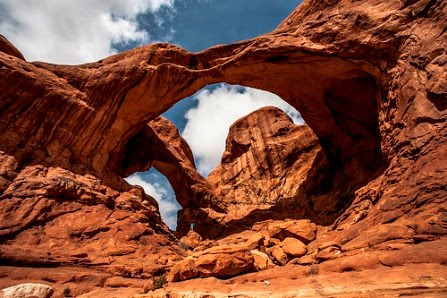
 There are different types of arches to be found in the park, wall arches, free-standing, pothole, and natural bridge arches. A wall arch backs up against a rock wall or cliff, examples can be seen in the windows area of the park. Biceps Arch and Park Avenue Arch are examples. Delicate Arch, the classic representation of the park, which is unique world-wide, is an example of a free-standing arch. Double Arch is another example of a free-standing arch.

Delicate Arch: a free-standing arch

Left:Biceps Arch, a cliff or rock face arch and Right: Double Arch, a free-standing arch.


A pot-hole arch is created when a pothole, or depression on a rock top merges with an alcove on the rock face, you can see the light inside of it; Pot-Hole Arch and Bean Pot Arch are examples. Natural bridges are stone bridges located near stream beds. Landscape arch at 306 feet is the longest natural bridge arch.
Bean-Pot Arch, a pot-hole arch.


Landscape Arch, a natural bridge.


 Other interesting facts about Arches National Park; Double Arch in the windows section of the park is 112 feet, Balanced Rock a unique park feature, is estimated to weigh 3577 tons, or the equivalent of 27 blue whales together. The most famous arch in the park is Delicate Arch. The opening is 46 feet (14 m), and the height is 60 feet (18 m) tall. Average elevation of the park is 5000 feet (1723 m). Arches National Park hosted over 1.6 million visitors in 2018 and has seen unprecedented numbers of visitors since the covid shutdowns of 2020 because Utah did not close down as much as some other states. All the National Parks in Utah have seen surges in visitors since early 2020.  Arches has the highest density of natural arches in the world.

Balanced Rock, Arches National Park, estimated weight for the balanced rock: 3577 tons.

Left:Slick-rock Cycling at Arches National Park.


Petroglyphs: Arches National Park, Moab, Utah.


Sunday, August 15, 2021

Exercise the brain!! For Kids and Adults

Usually August is considered the 'dog days' of summer because its really hot. Children and youth, and parents dealing with youth on summer break, start getting bored or frustrated while waiting for it to be back to school time. Where I live the month of July was definately the hottest of the summer, it has turned out to be the hottest July on record for this state! Weeks of scorching hot weather and a drought to add to it. Some parts of the country are now starting back to school, some have a week or two to wait yet. Here are some brain awakening exercises to get your students ready for back to school, or for you to fill an 'I feel bored today' day with, or for anyone wanting a few interesting activities for sharpening their brainpower.
ROYGBV is an abbreviation or acronym that uses the first letter of each color for the colors of the rainbow, in the order that they appear when you see an actual rainbow. (Red, Orange, Yellow, Green, Blue, Violet.) Fun writing ideas: On Monday write five sentences using the color red. On Tuesday write five sentences using the color orange. On Wednesday- write five sentences using the color yellow. On Thursday- use the color green. On Friday use the color blue. On Saturday use the color violet (after you do your Saturday chores, of course.)
You can make drawings of your sentences, too. If you are a little kid just make drawings of things using the colors. Examples of sentences using color words:

A smile appeared on my face when I saw the red of the cherry on top of the banana split.

Maybe if Red Riding Hood had worn a different colored cloak, she would have escaped the big bad wolf.

Yellow and black checkered taxi cabs could be seen everywhere in New York City.

Don’t eat yellow snow! 


Green smudges decorated several of the preschoolers' foreheads after the finger-painting activity.

 The frog peeked its head out of the green blanket of duck weed that covered the surface of the pond. 


Unscramblers

Unscramble these letters and find the names of three things that you can take with you everywhere:  (Find answers at the bottom of this page for these activities.)


1. E A G L E R E M Y  


2. What is unique about this sentence?

  The quick brown fox jumps over the lazy dog.  


3. Unscramble the five words below so that all five words rhyme:


              OOT, OHSE, WREG, ELBU, RKNAAOGO  


4. There are four types of trees hiding in the sentence below!

 The cloak and cap pleased my pal Mel mildly.

          (Each one reads from left to right, across one or more words. Can you spot them?)


Secret codes

Here are some examples:


Backwards alphabet code: A B C D E F G H I J K L M N O P Q R S T U V W X Y Z

 What the letters mean:      Z X Y WVU T  S RQP O N M L K J  I  H GF  E  D CB A


Write your name using this code:


Reverse code: Reverse the Words .........

This is a simple code to solve – just read the words backwards!

Try writing a message of your own.


Fun with poetry:

 Write your name vertically then using the letters of your name as the first letter, choose words that describe you and make a poem about yourself. Here is an example of a poem for a girl named Clara.....if your name happens to be Clara, you will have to think of new one...

 C ute

L ikes to laugh

A ble to draw dragons

R eady to snarf  pizza

A rtist in training


Answer page...don't peek until after you have tried to solve the riddles!!!!


 1. E A G L E R E M Y    

(eye, arm, leg)

2.  What is unusual about this sentence? The quick brown fox jumps over the lazy dog.   (This sentence contains all 26 letters of the alphabet at least once.)


         3. OOT, OHSE, WREG, ELBU, RKNAAOGO  (too, shoe, grew, blue, kangaroo)


4. Four trees: (oak, apple, palm, elm)


Reading Roundup...

I've reached a benchmark of reading 68 books out of my stated goal of 75, so far this year, it's time for an update. Over the years ...